There is only one dependable way to love life: to draw near to the limpidity that asks for patience, courage, sacrifice, and so often silence and self‑denial. And also for defeats, for the encounter with what contradicts us, for the labour of continual learning. Zbigniew Herbert, in a remarkable poem, writes, “I would like to describe the simplest emotion,” trading “all metaphors / for a term / torn from the chest like a rib / for a word / that fits / within the limits of my skin.”
With age we learn that nothing is quite as difficult as the limpidity of childhood—an equivocal yet precious gift. We learn that truth (like the sun) still casts its light and warmth, though it has shifted its place upon the horizon. The irony could hardly be sharper: as we grow older and confront physical short‑sightedness, we look more deeply into things, into the character of others (and of ourselves), into the perplexity of life, into the feeling stirred by little beings, into the pain dealt to us by ignorance and human savagery; we look more intently into the depths of the cosmos, of death, of the genuine happiness born in a poem; we look towards the comfort of friendly voices, towards the solemn wisdom of Vilhelm Hammershøi’s paintings, or the enchantment of the guitar chords of Isaac Albéniz or Joaquín Rodrigo. Life does not require wealth or genius to be worthy. It asks only for kindness and stillness. And with age we learn that nothing matters more than drawing close to our destiny, even if that destiny is a mirage. We recognise it by the confidence and quiet joy with which we open the door each morning. In the end, compassion is the reward of our discovery.
I write these words on a bright December morning, a cup of coffee warming my hands. I feel, far beyond myself, the harmony of space and the mind’s impetuous surge of effort. I might have taken up pencil and paper to write something entirely different. But I needed to set down this thought. Life chose us, as love chooses us, or as the gaze of someone seeking ours. I suppose that responding to such devotion is worth not only the effort, but above all the heart.
There was a time in Torben Bjørnsen’s life when his deeds flowed easily and applause reached him from every side. Success seemed without limit and he carried it in his gestures and in his words, for he was a fine writer and an even finer orator. The initials TB gleamed on bookish placards and university periodicals, but above all on the flyers and posters set at the entrances of the packed lecture theatres where he appeared so often.
But that was another time.
With no explanation we might offer the reader, Torben Bjørnsen flung himself into a harsh flight of self-erasure: he refused interviews, turned down invitations, forgot patrons and admirers, and sealed himself in a troubling muteness and solitude, as though he had suddenly needed to transform the empathetic skin of his former self into an armour of scales and spikes. For almost two decades he has produced no new writings, not even the brief prose poems we cherished so much.
Celebrity was followed by resentment and vendetta.
A kind of hatred for the man has taken root in Denmark, a country which, like all others, accumulates both noble and rotten makers of public opinion. Some claim Torben fled the reach of justice, guilty of some offence drawn from the spectrum of social aberrations. Others explain his silence through a profound religious conversion, the sort one does not expect in days so stripped of spirituality as ours. There are those, too, who justify the change with a single word: weariness.
Ida Kjær, a mutual friend, told us recently that she meets him once a year.
Torben does not live in Greenland, in the Faroe Islands, nor on any of those islets on the way to Sweden. He lives where he has always lived, with his cat, with his collection of nativity scenes, with his endless notebooks where he scrawls emendations and runic symbols. “Only older, much older, and filled with that childlike glow that draws us, on this Saint Lucy’s Day, in a crowd to the lighted canals. Torben will be there, anonymous and content, sharing and receiving lussebullar. You’ll see!”
The old man gathered every matchstick he could find. At first they took him for one of those model builders of castles and ships. But no one ever saw him create anything, not a single piece, and so, in time, they began to see him as a madman.
The small, burnt sticks give a beautiful sense of what our life is and what our death is. Some lose their heads easily, others keep their full ashen heads and charred bodies. When joined with patience and calm, they form palisades, bridges, rafts between the realm of the living and the realm of the dead. They resemble poems written to last a miraculous instant and a forever tinged with sorrow. One must understand them.
In December, when the days fade earlier, just before Christmas, they found the old man dead at home. He lay stretched on the floor, inside a gigantic cage made of thousands and thousands of those enchanting fragments of burnt wood. It was a poor mausoleum.
Whether it sheltered him or held him captive, no one has ever managed to understand from what, or why.
One of Herberto Helder’s most celebrated poems begins: “Amo devagar os amigos que são tristes com cinco dedos de cada lado” / “I love slowly the friends who are sad, with five fingers on each side” (“Aos Amigos,” Poemacto, 1961). Nothing gives itself to us—or gives us so deeply to others—as our hands do. The touch of hands trains our feelings, soothes the wretched, supports the powerless, opens places of refuge and hope to strangers and wanderers, draws in both the different and the familiar, seals pacts, builds bridges, and writes the essential words that the future will allow to take root.
On their skin, in the varied form of the fingers (as though the blessed difference of size and function made them inseparable creators of life), in the beauty of the nails, in the small blue threads of blood running to the tiniest venules and arterioles, in the lines where their phalanges bend and the full shell of their bones closes—there lies a science of fire.
By this science of fire I mean the gift we all possess (and so often refuse): the gift of loving, even in shadow, even in silence, on the humble scale of those who bring forth not injury but a poem, not hatred but friendship, not a hostile fist but an open and willing hand.
Herberto ends his poem with prophetic lines: “– Temos um talento doloroso e obscuro. / Construímos um lugar de silêncio. / De paixão.” / “– We have a painful and obscure talent. / We build a place of silence. / Of passion.” The world of men will only be saved when they understand what their hands are for—when they love the sad ones who keep them open, with five fingers on each side.
Suddenly I grasp the bestiality of humankind as I never had in nearly half a century of life. What is desecrated is the commonplace, the place of others, one’s own place. Each person becomes a latent enemy, a possible hatred, a quarrel, an insult, an act of aggression, a predatory gesture. I see how easily someone is wounded—without cause, without reason, without any concern for what each act is or signifies: a driver abandons his car to raise a violent arm against the one behind him; a ten-year-old hurls a death threat in class, at a fellow pupil or at the teacher; a patient dies on a hospital stretcher before the very eyes of the doctor meant to heal him; a president slanders and divides his people, scorning the oath sworn upon the Bible; a once-decimated nation commits mass murder, justifying force with the cowardly, hypocritical justice it claims to inherit. And suddenly I realize that the clear sun spilling across the windowsill and the blank page of my notebook is impure, unbearable.
I turn to Johann Sebastian Bach as a leper to his refuge. I turn to childhood, to the memory of good friends, of the idyllic walks to primary school, of the ancestral scent of herbs along the streams. I turn to the rigor of colors, the unequivocal weight of words, the care of nails, the truth in the eyes. Then, there was an immeasurable sense of hope. I learned to respect, to give thanks, to be gentle, to cultivate humor, to cherish the rare, beautiful objects given to me, to read books with delicate care, to press my spirit into the considered phrases I was asked to set down—one after another—in school compositions and in dialogue of subtlety. I turn to silence to remember all of this, to listen to the guitar suites, to step away from the noisy patina the days secrete.
The other day a student asked how I find inspiration. For an instant a banality hovered on my lips, a cliché, a ready-made reply. We were in a long room lined with state-of-the-art computers, breathing the air steeped in cables and devices. We were speaking of António Vieira, and of the courage to preach on the edge of the abyss. «I don’t know», «I never knew». That is the certainty. Inspiration—like opening one’s chest to the clean October air, brushing against dew, against the bright green of fennel and lemon verbena—I cannot explain it. Unless, perhaps, as a vast nostalgia, a melancholy urge to reinvent the days backwards, as when the pencil snapped along the nervous line and I thought «this is not the way». Suddenly humanity crumbles on the page, swollen with stupidity and perverse pride. And it is necessary that someone say «this is not the way».
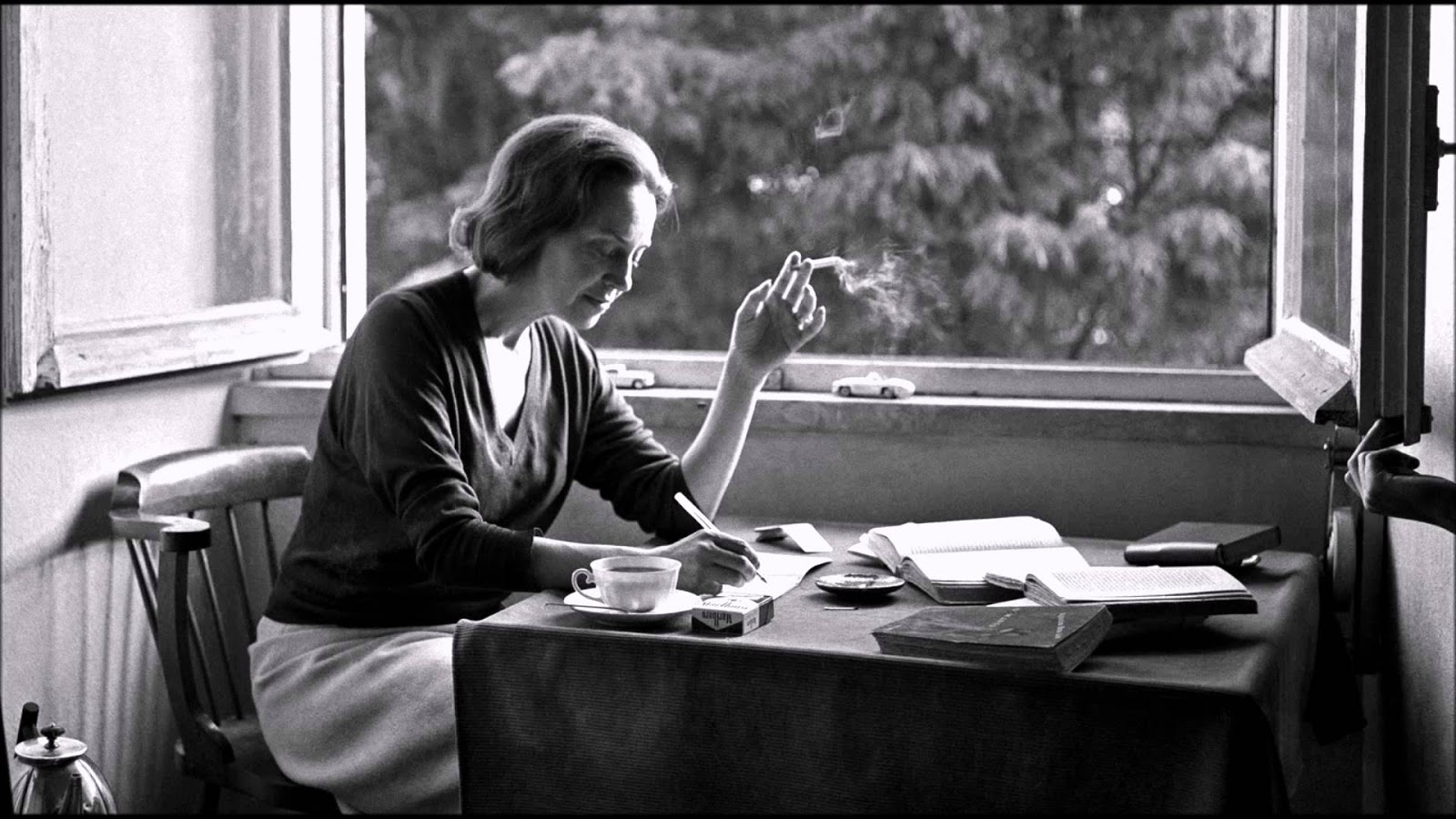
Sophia de Mello Breyner Andresen photographed by Eduardo Gageiro
.
In one of the poems of No Tempo Dividido, Sophia de Mello Breyner Andresen writes, in the manner of an inscription: “Que no largo mar azul se perca o vento / E nossa seja a nossa própria imagem” — “That in the wide blue sea the wind be lost / And ours be our own image.”
The pelagic world was for the poet, as is commonly known, a demiurgic, almost religious space, from which emerged her creative force, her fascination with ancient time (which was equally her fascination with the inscrutable future), but also her most personal delight in the peoples who, having sailed those seas of a remote past (the Greeks, in particular), bequeathed to us their art, their beauty, their nude, and within them (as in Heidegger’s ontology) our destiny.
Sophia’s poems are, without exception, exercises in incomparable lapidary art. We read them today under the relative oblivion to which every work is consigned after the death of its author. Yet for this very reason we rediscover them as more vehement, more marvellously sculpted, more true. We read them as an extension of ourselves, as though seated on a garden bench among the twisted trunks of giant trees (like these metrosideros in Foz do Douro), the wide blue sea before us seemed more real, and our own spirit wandered amid those waves and the scent of the sea breeze, while between the seated body and the wandering spirit there existed something unnameable. Something like our own image, doubly beheld in the mirror.
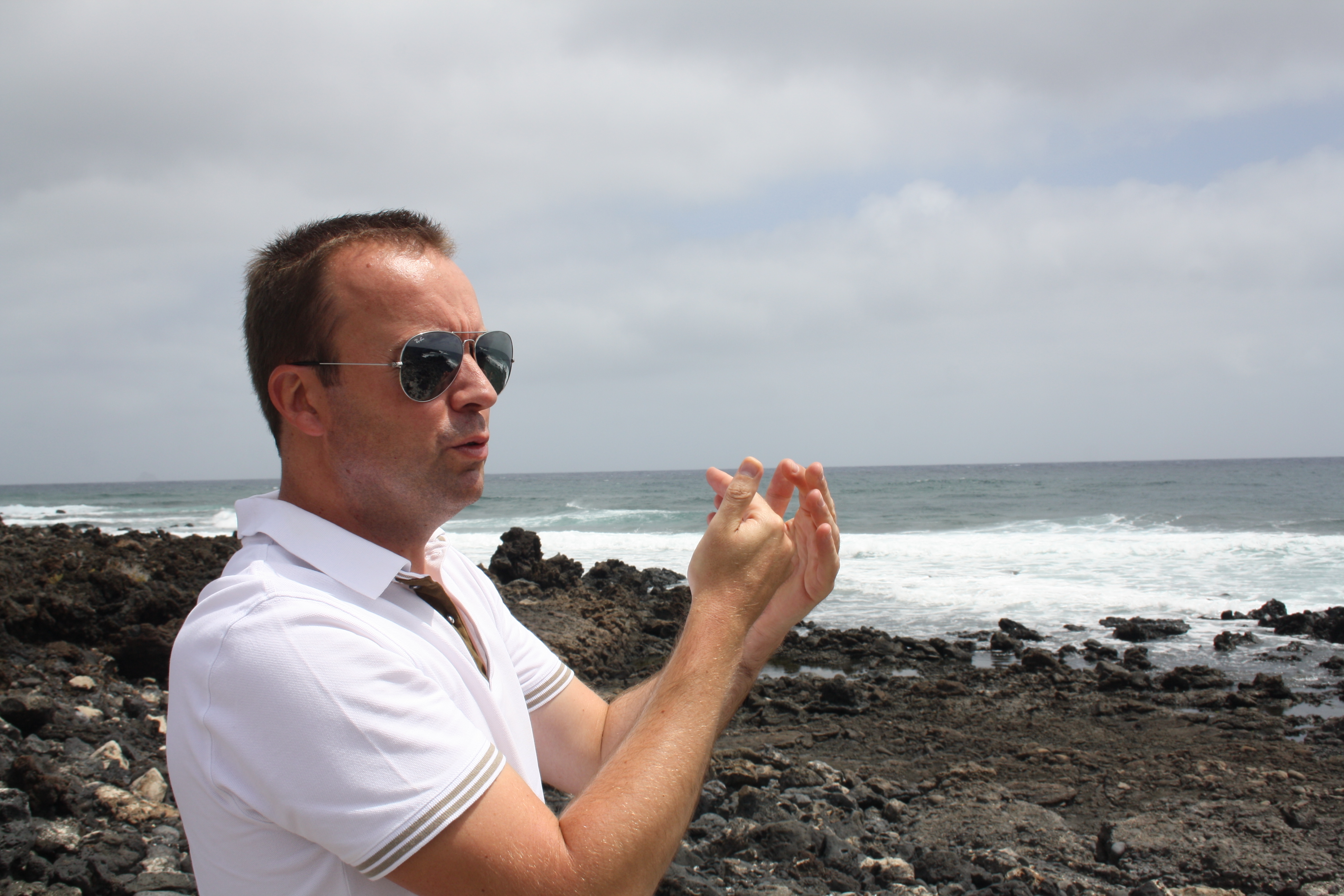
João Ricardo Lopes op Lanzarote – gefotografeerd door Catarina Lopes (2018)
.
Binnen de Portugese literatuur, en in het bijzonder binnen de moderne Portugese poëzie, onderscheidt zich steeds duidelijker de eigenheid en originaliteit van João Ricardo Lopes, een schrijver geboren in 1977, wiens werk een groeiende belangstelling heeft gewekt in de vorm van studies, vertalingen en literaire onderscheidingen.
Afgestudeerd in Moderne Talen en Letterkunde aan de Universiteit van Porto en met een postgraduaat in Literatuurtheorie, bouwt deze dichter en romanschrijver zijn oeuvre op rond thematisch uiteenlopende invalshoeken. Soms maakt hij gebruik van humor en ironie als middelen om geschiedenis, mens en kunst te ontheiligen; andere keren hanteert hij een lyrische (bijna elegische) toon om het Grieks-Romeinse verleden, zijn landelijke jeugd of het onthechte leven van kluizenaars op te roepen.
In zijn subtiele parodie, in het spel van toespelingen en suggesties, in het citeren van klassieke en moderne auteurs, schuilt zowel een oprechte eerbied als een kritische afrekening met de holle en pompeuze retoriek waarmee literatoren vaak middelmatige namen en ideeën tooien. Voor de oplettende lezer is de beeldende kracht van zijn verzen en verhalen onmiskenbaar, evenals de relevantie van de beschouwingen die erin vervat liggen – een duidelijk bewijs van zijn betrokkenheid bij humanistische en ecologische kwesties.
Tot nu toe publiceerde hij zeven dichtbundels, een verhalenbundel en een bloemlezing van kronieken. Wij kozen ervoor een selectie van ongepubliceerde gedichten van de auteur te presenteren, losstaand werk, verspreid over de tijd, om zo de veelzijdigheid van zijn poëtische creatie beter te illustreren.
ik weet nooit wat ik ga zeggen.
ik ben pessimist sinds mijn geboorte.
de dingen duiken op, al geschreven
.
toen ik het huis van de schrijver bezocht
voelde ik dus helemaal niks
op welke bladzijde stond dat dan?
.
ik slaap nu zo
de lamp aan, de regen die brandt,
de bladeren met wijd open ogen in het donker
.
de lamp slikt het duister
met de olympische traagheid van een zwart gat
lieve voeten, wacht op je beurt!
.
het uur van de drukfouten, wild.
achter de schermen: de erwtentuinen, de molen, de vervloekte rivier
hoe schrijf je IK in Romeinse cijfers?
.
om twaalf uur de prachtige lange eenzaamheid van lege wegen.
de auto is een draaimolen
die herfst speelt met de zon
.
ik heb niet veel vrienden, dat is waar…
geen twee.
één
.
de middag rust op het kopje.
de koffie is mooi: drink hem langzaam.
het landschap is goed: neem gerust wat je wilt!
.
het wiegen van die heupen
doet me denken:
wat is een gedicht?
.
een deel van mij doet pijn
jouw borsten,
tepelhoven, tepels, angoratrui
.
wie mij streelt heeft geen gezicht.
zweeft tegenlicht in, koude handen, bergamotparfum
zo wil ik sterven
.
deze weg brengt me naar de nacht
jouw huis? hoe laat is het?
waarom vraag je dat?
.
in de zeef bleven alleen de kleinere vissen over.
de resten – mijn lievelingsgerecht
ik heb nooit honger gehad
.
fluweel:
een brandende lamp, een lucifer, een sigaret voor twee.
ik ken je naam nog niet
.
samenvatting van het leven tot nu toe:
waterpokken, bof, blaasjes, een goedaardige tumor,
puntjes
20.11.2012
.
MOSCOVO, ODESSA, BERLIM, COMPENHAGA, AMESTERDÃO, MADRID, AVULSOS, TU
um poema pequeno.
todos os grandes pisam em volta
cuidado com os tacões!
.
nunca sei o que vou dizer.
sou pessimista desde que nasci.
as coisas aparecem escritas
.
quando visitei a casa do escritor
senti rigorosamente nada
em que página foi isso?
.
durmo agora assim.
o candeeiro aceso, a chuva a arder,
as folhas com os olhos bem abertos no escuro
.
a lâmpada engolindo a treva
com o vagar olímpico de um buraco negro
queridos pés, esperai pela vossa vez!
.
a hora das gralhas, selvagem.
nos bastidores os ervilhais, o moinho, o rio amaldiçoado
como se escreve EU em numeração romana?
.
ao meio-dia a magnífica longa solidão das estradas vazias.
o carro é um carrossel
a brincar ao outono com o sol
.
não tenho muitos amigos, lá isso…
nem dois.
um
.
a tarde poisa na chávena.
o café é belo: bebe-o devagar.
a paisagem é boa: serve-te à vontade!
.
menear as ancas desse modo
faz-me pensar:
o que é um poema?
.
uma parte de mim dói-me
os teus seios,
auréolas, mamilos, camisola de angorá
.
quem me acaricia não tem rosto.
flutua a contraluz, mãos frias, perfume de bergamota
quero morrer assim
.
esta estrada conduz-me até à noite
a tua casa? que horas são?
porque mo perguntas?
.
no crivo sobraram os peixes menos graúdos.
os sobejos – o meu prato preferido
nunca passei fome
.
veludo:
uma lâmpada acesa, um fósforo, um cigarro para dois.
não sei ainda o teu nome
.
resumo da vida até agora:
varicela, parotidite, bexigas, um cancro benigno,
reticências
20.11.2012
.
•
FEBRUARI, HERMAN DE CONINCK
ik, die eigenlijk verdrietig zou moeten zijn, ben het niet.
ik drink de nevel als een oude bootsman
met zijn glas rum in de hand
moed verzamelen
doen we allemaal, vlak voor we een deur openen
en laten kijken
hier vanbinnen!
wat een vreemde plek
en toch helemaal van ons!
ik, die eigenlijk verdrietig zou moeten zijn, glimlach.
ik sta open voor elke vorm van klappen.
ik verstop me nergens achter
06.02.2014
.
FEVEREIRO, HERMAN DE CONINCK
eu que deveria estar triste não estou.
bebo o nevoeiro como um velho passavante
agarrado ao copo de rum
ganhar coragem
é o que todos fazemos, antes de abrirmos uma porta
e deixarmos que espreitem
cá dentro!
que lugar tão estranho
e tão nosso!
eu que deveria estar triste sorrio.
estou disponível para toda a espécie de pancadaria.
não me escondo atrás de nada
21.02.2014
.
•
.
SENTIMENTALITEITEN
wat een watje,
de lamp wil me vanavond
iets vertellen.
ik doe het licht uit.
dan begint de stilte te jammeren
tegen de muren van de kamer.
ik haat het als dat gebeurt
06.03.2015
.
LAMECHICES
lamechas,
o candeeiro quer contar-me esta noite
qualquer coisa.
desligo a luz.
então o silêncio choraminga
às paredes do quarto.
odeio quando faz isso
06.03.2015
.
WE HADDEN KUNNEN
rond het middaguur zijn de schaduwen voorbijvarende schepen.
van ver komen de woorden, zoals ook wij onszelf naderen
we hadden gelukkig kunnen zijn, jij en ik,
zoals klaver en brandnetel!
06.08.2015
.
PODÍAMOS
ao meio-dia as sombras são navios passantes.
de longe as palavras chegam, como nós chegamos a nós mesmos
podíamos ter sido felizes, tu e eu, podíamos,
como o trevo e a urtiga!
06.08.2015
.
•
ODYSSEE
(TERUGKEER VAN ODYSSEUS, DE DWAAS)
mijn oude, je had niet zo lang op mij moeten wachten.
van de zee bracht ik dit blind-zijn van zeewier mee
en prostaatkanker,
bracht de as mee die de nimfen en de sirenen
(en de zwarte spin van Ogygia)
in mij hees
ik reisde door zoveel bedden als er eilanden zijn in de Middellandse Zee
en jij noch ik hebben schuld of redding
Telemachos, nog zo’n kind en toch al zo sterk
verouderd is de boog die me de afgrond in slingert
langs kliffen van buizerds en spaarzame olijfbomen
beneden is het schuim dat mij doodt.
heb ik je gezegd dat ik wil sterven?
blijf dan maar weven, nutteloze koningin!
uit klippen is het leven opgebouwd,
twintig jaar branden knagen tot op het bot
en dan niets meer, alleen ziekte, alleen het kale eiland,
alleen de herinnering die vliegt en vliegt tot ze vergaat
of iemand er een epos van maakt,
en liegt, liegt, liegt
.
(PENELOPE TOT ODYSSEUS)
ik weet eigenlijk niet eens of ik van je hou:
misschien hou ik van je zoals van geitjes,
eerst zo onschuldig en dan niet meer.
misschien verlang ik naar je in datzelfde ergastulum
je daalt de heuvel af met je oude bel,
ik voel je naderen
(nu nederig, vroeger niet),
en ik streel je rug,
tel de dagen die nog resten
(mijn wraak,
deze vage flits van vrouw-zijn tot in mijn ingewanden),
om je toe te lachen
en je in de nek te steken
17.05.2017
.
ODISSEIA
(REGRESSO DE ULISSES, O TOLO)
minha velha, não esperasses tanto por mim.
trouxe do mar esta cegueira do sargaço
e o cancro da próstata,
trouxe as cinzas que as ninfas e as sereias
(e a aranha negra de Ogígia)
içaram em mim
viajei por quantas camas insulam o Mediterrâneo
e nem tu nem eu temos culpa ou salvação
Telémaco, tão criança é ele ainda e tão forte já
envelheceu o arco que me arremessa a pique
nestas escarpas de búteos e oliveiras escassas
lá em baixo é a espuma que me mata.
disse-te que quero morrer?
fica pois tecendo, rainha inútil!
é de escolhos que a vida se faz,
vinte anos de ardimento roem até ao osso
e depois mais nada, só a doença, só a ilha despida,
só a memória voando e voando até soçobrar
ou alguém fazer com ela uma epopeia,
e mentir, mentir, mentir
.
(DIRIGE-SE PENÉLOPE A ULISSES)
na verdade, nem sei se te amo:
talvez te ame como às cabrinhas,
tão inofensivas primeiro e depois não.
talvez te deseje no mesmo ergástulo
desces a encosta com o teu antigo chocalho,
sinto-te aproximar
(agora humilde, antes não),
e eu acaricio-te o dorso,
conto os dias que faltam
(a minha vingança,
este lampejo indefinido de mulher que sou até às entranhas),
para te sorrir
e apunhalar no cachaço
17.05.2017
.
•
WINTEROCHTEND
een schaaf om het hout af te schaven,
schuurpapier, vernis en verdunner,
de wapenstilstand – de winter bijvijlen
Bach over het huis, een gedicht:
bricolage van topklasse, het hart gezuiverd,
als herboren!
18.02.2018
.
MANHÃ DE INVERNO
uma plaina para descamar a madeira,
lixa, verniz e diluente,
o armistício, corrigir o inverno
Bach sobre a casa, um poema:
bricolage de primeira, o coração limpo,
como novo!
18.02.2018
.
•
DE GINKGO BILOBA’S VAN HIROSHIMA
voor Tsutomu Yamaguchi, maritiem ingenieur, de bekendste van de hibakusha
voor Akira Hasegawa, leraar, wiens lichaam en huis in de lucht verdwenen, als vlinderpoeder
.
na de verschrikking moest de stad worden gereinigd.
de keizerlijke ambtenaren kwamen in ploegen,
staken hun schoppen in de stoffige resten van steen,
veegden de modder van de ene naar de andere kant,
hoorden de wind janken in de as – het ergste van alles was
dit gefluit van de stilte, het piepen van ijzer in de glasloze raamsponningen,
in het puin van bruggen die kraakten als scharnieren,
in hoofden die trager stierven dan de rest van het lichaam
de ambtenaren van het rijk kwamen
en gingen in ploegen
soms namen ze ontroerd hun pet af,
bewaarden in kleine sarcofagen van cederhout
de skeletten die niet geheel door het grote vuur waren verteerd
het was nodig – het was nodig –
het denken opnieuw op de kaart te tekenen:
daar was de dierentuin, ginds de lagere school,
dat daar – die verbrande schaduw op de stoep – een vrouw
met haar kind in de armen
soms viel men op de knieën op precies die plek
waar een kus, een afscheid,
of een ongeschonden ritueel zich had verscholen
nooit leken woorden zo schaars tussen het puin,
zo bitter,
zo waanzinnig
maandenlang herhaalde zich het afbreken, het vergeten,
het doorgaan – het ergste van alles was
de pit van de dood,
hoe zij de keel opensperde
en bleef
Ichiro Kawamoto, aan wie Philip Levine
een indrukwekkend gedicht wijdde, zei dat er in het voorjaar van ’46
een wonder gebeurde:
ergens in maart ontsnapte wat groen
aan het helse landschap
– we keken en zagen knoppen groeien aan de verbrijzelde takken
van de ginkgo biloba’s,
kleine uitlopers vol sap kwamen weer tot leven
en dat – dachten de ambtenaren van de keizer –,
dat – denken wij – dat betekende iets
21.03.2024
.
AS GINGKO BILOBAS DE HIROSHIMA
Para Tsutomu Yamaguchi, engenheiro naval, o mais célebre dos hibakusha
Para Akira Hasegawa, professor, cujos corpo e casa desapareceram pelo ar, como pó de borboletas
.
depois do terror foi preciso limpar a cidade.
os funcionários imperiais vinham em turnos,
metiam as pás nos restos polvorentos da pedra,
varriam a lama de um lado para o outro,
ouviam o vento ganir nas cinzas – o pior de tudo era
este assobio do silêncio, esse guinchar do ferro nas aérolas sem vidro,
nos escombros das pontes que dançavam como dobradiças,
nas cabeças que morriam mais devagar do que os outros órgãos
os funcionários do império iam
e vinham em turnos
às vezes retiravam e apertavam o barrete cheios de comoção,
guardavam em pequenos sarcófagos de cedro
os esqueletos não inteiramente consumidos pelo grande lume
foi preciso – foi preciso – reaprender
o mapa do pensamento:
ali era o zoológico, acolá a escola primária,
aquilo – aquela sombra calcinada no pavimento – uma mulher
com o filho ao colo
às vezes caía-se de joelhos no lugar exato
que havia sido o esconderijo puramente intacto de um rito,
de um beijo, de uma despedida
nunca as palavras se pareceram tão poucas no entulho,
nem tão amargas,
nem tão dementadas
meses a fio repetiu-se o desmantelar, o esquecer,
o prosseguir – o pior de tudo era
o caroço da morte,
o modo como escancarava ela a garganta
e permanecia
Ichiro Kawamoto, a quem Philip Levine dedicou
um poema portentoso, afirmava que na primavera de 46 aconteceu
um milagre:
aí por meados de março, algum verde soltou a língua
na paisagem infernal
– olhávamos e víamos brotos sair dos ramos espedaçados
das gingko bilobas,
renasciam pequenas pontas impregnadas de seiva
e isto – pensavam os funcionários do imperador –,
isto – pensamos nós – isto queria dizer alguma coisa
21.03.2024
.
•
VAN HET LICHT
het was ongetwijfeld op een ochtend als deze
geboren uit de mildheid van het licht
zonder listen,
zonder gewichtigheid,
zonder slinkse nagels in de schaduw,
dat Vilhelm Hammershøi schilderde
wat ook Vermeer in zijn portretten zag
of wat Fra Filippo Lippi raakte
in het gezicht van Lucrezia Buti
wij raken de dingen niet aan,
wij worden eerder geraakt door de lichte en rustige beweging
die tussen hen en ons
de tangentiële diepte van de geest is
of, anders gezegd,
onze blik die zich met de lens van het gedicht verzoent
08.06.2024
.
DA LUZ
foi indubitavelmente numa manhã assim
nascida da indulgência da luz
sem vafrícia,
sem balofice,
sem unhas iníquas na sombra,
que Vilhelm Hammershøi pintou
o que também nos seus retratos viu Vermeer
ou o que no rosto de Lucrezia Buti atingiu Fra Filippo Lippi
não tocamos as coisas,
somos antes tocados pelo movimento leve e sereno
que entre elas e nós
é a profundidade tangencial do espírito
ou, dito de outro modo,
é o nosso olhar reconciliado com a lente do poema
08.06.2024
.
•
KLEIN EERBETOON AAN DE CITROENEN
voor Céu
.
ik weeg ze in mijn hand, streel hun gerimpelde schil,
het mosgroene stof dat rust tussen de kronkels van hun
rug.
daarna zijn ze in de fruitschaal onvermijdelijk de zon, licht
dat het huis met vreugde verwarmt
het mes dat ze doormidden snijdt, vult zich met hun
transparante, geurende – en bittere – bloed,
en de neusvleugels ademen hun levendige
en krachtige aanwezigheid
geen enkel voedsel veracht het nederige
afscheiden van deze citrusvrucht, zoals ook het geheugen
de stem van oude meesters niet verwerpt, die we ooit hadden
en die ons eens de onbreekbare fatsoen
van de pen op het schrift oplegden
ik zou zeggen dat het bloed van de citroenen zuiver is
en misschien een beetje droevig,
maar nooit onschuldig – nooit onverschillig
25.03.2025
.
PEQUENO ELOGIO AOS LIMÕES
para a Céu
.
sopeso-os na mão, acaricio-lhes a pele enrugada,
o pó-verdete repousando entre as volutas do seu
dorso.
depois na fruteira eles são invariavelmente o sol, luz
que a casa acalenta com prazer
a faca que os corta pela metade enche-se do seu sangue
translúcido e perfumado – e amargo –
e as narinas ventilam a sua presença vívida
e pujante
nenhum alimento desdenha o segregar humilde
deste citrino, como não o faz a memória
à voz de velhos mestres que se tiveram, e que outrora
nos impunham a decência inquebrável
da caneta sobre o caderno
diria que o sangue dos limões é cândido
e talvez um pouco triste,
mas jamais inócuo – jamais indiferente
25.03.2025
.
•
DE FÜHRER IS GAZA BINNENGEGAAN
de Führer is Gaza binnengegaan
hij is niet levend verbrand in benzine
want de Führer is onsterfelijk
zo voorspelden de bezems die de bunker
in Berlijn schoonmaakten:
de Führer is niet gestorven
de Führer is Gaza en Donetsk en de Krim binnengegaan
en misschien hapt hij naar Groenland en Taiwan
en scherpt hij zijn schorpioenentangen op zoek naar meer kaart
de Führer is opnieuw opgestaan in de stilte
zijn beste artillerie is de stilte
de Führer is een melaatsheid die van hand tot hand wordt doorgegeven
beter was het als hij in de zon was verbrand
en niet in haat
dat de Führer Gaza is binnengegaan
is mijn overtuiging: als ik me vergis,
zeg het me
21.05.2025
.
O FÜHRER ENTROU EM GAZA
o Führer entrou em Gaza
não morreu assado em gasolina
porque o Führer é imortal
assim previram as vassouras que limparam a casamata
em Berlim:
o Führer não morreu
o Führer entrou em Gaza e em Donetsk e na Crimeia
e talvez abocanhe a Gronelândia e Taiwan
e afie as tenazes de lacrau à procura de mais mapa
o Führer reergueu-se no silêncio
a sua melhor artilharia é o silêncio
o Führer é uma lepra que se inocula de mão em mão
antes tivesse ardido em sol
e não no ódio
que o Führer entrou em Gaza
é a minha convicção: se me equivoco
dizei-me
21.05.2025.
Biografische notitie, gedichtenkeuze en vertaling: Petrus van der Laan.