I crossed the Museumplein as fast as I could toward the Rijksmuseum. Lunch — a hot dog hastily eaten at one of the Hema shops near Vondelpark — was rising in my throat. Heavy showers had fallen earlier in the morning, in stark contrast with the scorching start to that early October afternoon. I had to dodge puddles and splash my face with water before arriving at the office of the curator, Evelijn van Buyten.
“Christiaan, I don’t quite know how to explain this. It’s a strange case. The best thing is to start with a field inspection…”
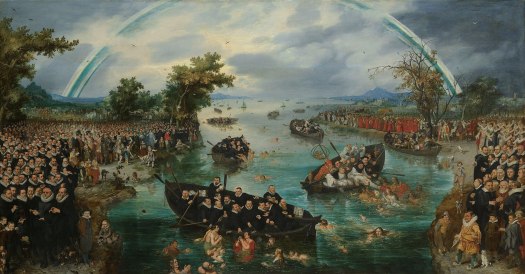
I was led to the Flemish Masters section on the second floor and placed in front of De zielenvisserij by Adriaen Pietersz van de Venne. Then, in a gesture worthy of a detective, Dr. van Buyten said:
“Please, see if you notice anything unusual here!”
I scanned the painting. The canvas (a masterpiece dated 1614, with the considerable dimensions of 98.5 by 187.8 centimeters) depicts a river densely filled with boats and shipwrecked souls between the overcrowded banks of a typical Dutch polder: on the left, in somber black and beneath leafy trees, the Protestant mob; on the right, more flamboyant and splashed with the red of prelates, a Catholic crowd in the wake of Archduke Albert of Austria.
The fishing for souls is intense, the boats threatening to capsize from the weight. The Pope himself, adorned with his array of symbols, participates in the pious collection of souls. In the background, the only sign of Christian unity, a pale rainbow forms a bridge between the two enemy processions.
“Let me have a closer look…”
I adjusted my glasses, raised the magnifying glass, and carefully reviewed the details. The oil painting, in tones characteristic of the Dutch school, displayed a wide chromatic range from bistre to sky blue. The figures seemed authentic, the Bibles remained open, the beards pointed, the hands piously raised…
“The horsefly, Christiaan!” the curator interrupted impatiently.
Indeed, the horsefly had vanished. I was stunned by my own oversight. The horsefly, which van de Venne had placed like a satirical signature on the greenish waters, was gone.
“Good heavens, we’re dealing with a forgery!”
“You have to see something, Professor,” said the head of security.
“What you’re about to see goes beyond us… It’s simply absurd,” Dr. van Buyten announced.
I was taken to an overheated room, where countless monitors connected to a multitude of surveillance cameras showed the Rijksmuseum’s inner workings. Then, by fast-forwarding footage recorded during the night, they showed me a video clip.
“It starts here,” said Jan Nerrings.
In the computer pixels, a crowd began to move, noisily, on both sides of the river. Heads turned, arms were raised, eyes opened wide, prayers and curses were uttered, oars struck the water, the barges rocked as a wave rippled through the current, the fishermen strained to pull in the naked bodies. Like a film animation, for no more than thirty seconds, the trees swayed and birds crossed the horizon. Then, as the other figures froze once more, the large insect, seemingly weary of its exogenous presence, beat its wings and fled.
Over a remarkable journey, which successive cameras captured, it flew through rooms and corridors of the Rijks, looped and hovered over other masterpieces, and finally headed for an air duct and disappeared.
“From this point on, we can’t see anything else,” Nerrings lamented.
“Absurd, completely absurd…” the curator murmured.
I asked to see the footage again. I reviewed it several times. Then I returned to the canvas. I suspected a prank. A dreadful thought struck me—that I had become trapped inside a solipsistic mind. Perhaps I was dreaming. I could neither confirm nor dismiss any theory. None of it was even remotely plausible.
“Absurd, completely absurd…” repeated Dr. van Buyten, perplexed, inconsolable.
As expected, the event stirred strong passions in the public. That an animal would seek its freedom—even after four centuries—should not surprise us so much, noted an expert in ecology and international law.
And indeed, it shouldn’t.
..Text by João Ricardo Lopes
Official Website: https://joaoricardolopes.com