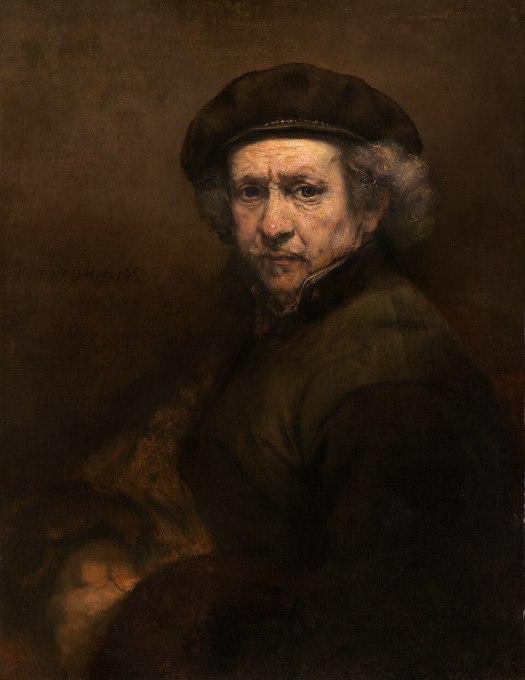
Rembrand, Self-Portrait with Beret and Turned-Up Collar, 1659
.
REMBRANDT’S SADNESS
the question was always this: can someone’s sadness, at any time, in any place, ever find a way to be satisfied?
we have our doubts about the matter
sadness shares with water the sin of avarice. first it skips about, then it digs itself in, and a little further on it hollows out sombre lights through the hills, one day it cuts across our path
“you shall not pass,” it writes under its breath, “you shall not pass”
let us consider the case of Rembrandt Harmenszoon van Rijn
his pain seems limitless, growing from portrait to portrait, like a river that knows itself unstoppable in its predatory course
looking into his eyes as they look into the mirror, we see Saskia and the promissory notes, old age imprinted in the swellings and the cracks of the skin
what is the size or the depth of his grief?
we have an idea about the matter, water is a good term of comparison
one day it makes us sink into a delirium of silver‑gelatin paper. but not even there, not even then, does it show itself fully sated. sadness will not abide the earth’s crust, its kingdom lies in the deepest hells, or even beyond them.
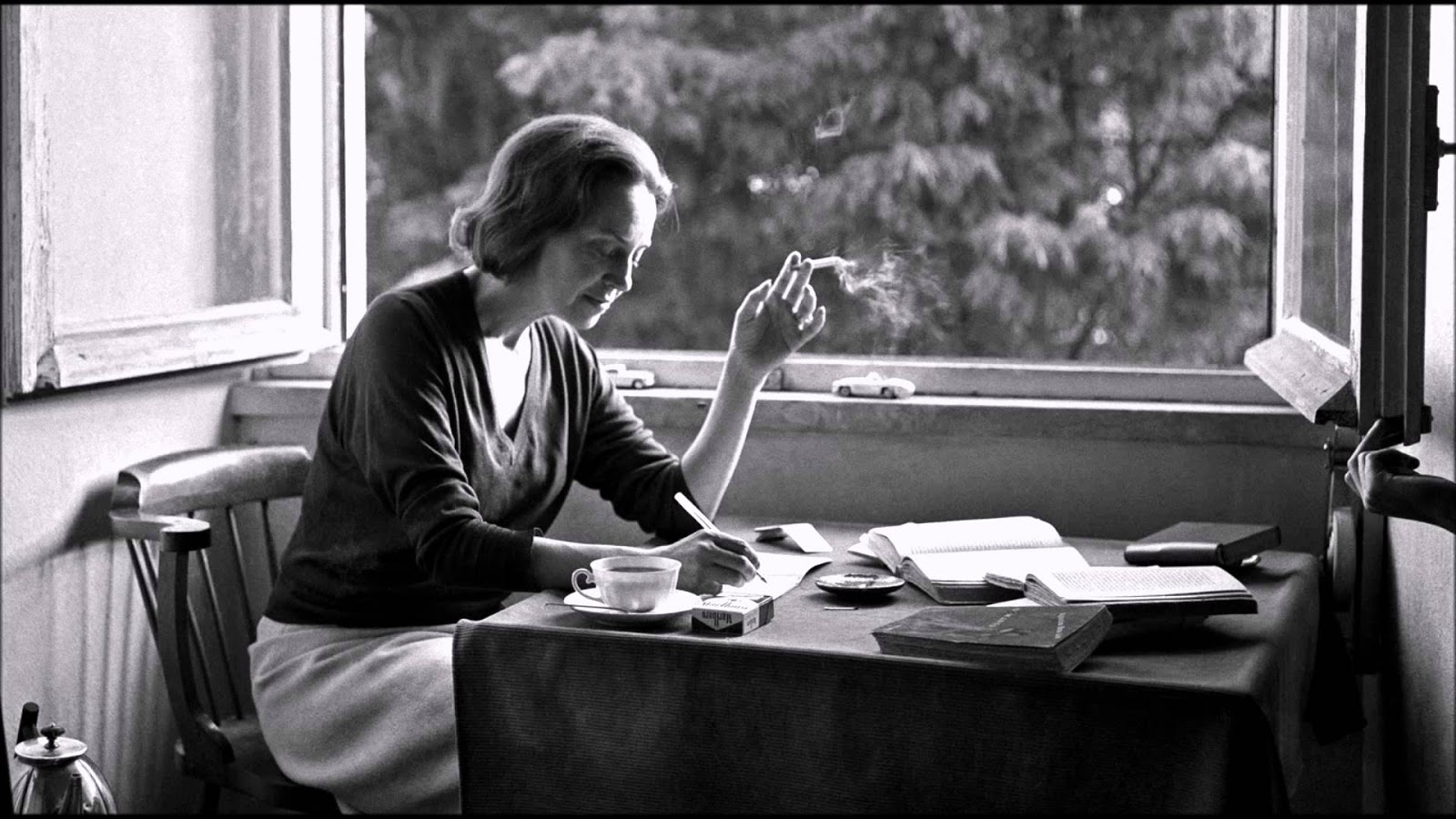
Sophia de Mello Breyner Andresen photographed by Eduardo Gageiro
.
In one of the poems of No Tempo Dividido, Sophia de Mello Breyner Andresen writes, in the manner of an inscription: “Que no largo mar azul se perca o vento / E nossa seja a nossa própria imagem” — “That in the wide blue sea the wind be lost / And ours be our own image.”
The pelagic world was for the poet, as is commonly known, a demiurgic, almost religious space, from which emerged her creative force, her fascination with ancient time (which was equally her fascination with the inscrutable future), but also her most personal delight in the peoples who, having sailed those seas of a remote past (the Greeks, in particular), bequeathed to us their art, their beauty, their nude, and within them (as in Heidegger’s ontology) our destiny.
Sophia’s poems are, without exception, exercises in incomparable lapidary art. We read them today under the relative oblivion to which every work is consigned after the death of its author. Yet for this very reason we rediscover them as more vehement, more marvellously sculpted, more true. We read them as an extension of ourselves, as though seated on a garden bench among the twisted trunks of giant trees (like these metrosideros in Foz do Douro), the wide blue sea before us seemed more real, and our own spirit wandered amid those waves and the scent of the sea breeze, while between the seated body and the wandering spirit there existed something unnameable. Something like our own image, doubly beheld in the mirror.
They brought him ivory, and he carved it with the most refined patience of which the human kind is capable. The objects that came from his hands were among those most ravenously coveted by foreigners in Brazzaville, in Djambala, in Sibiti, in Mandigou, and throughout the Congo. They called him “The Blessed One,” though his real name was Isidor Nkobanjira. As he grew old, he boasted of having no fewer than seventy children.
Near the end, he began to cut and pierce and carve deep grooves into an elephant tusk. First, he etched the winding course of a river, then the rise of a mountain, then a flurry of perfectly hemispheric stars. With care, he added water and fish, earth and impalas, sky and vultures. He filled the ivory with every creature he could remember, omitting neither silence, nor death, nor fear.
“The whole universe fits here,” Nkobanjira thought.
But in truth — he noticed with a look of dissatisfaction — after all was done, a bit of space still remained.
For Maria Alice Pereira Costa, my mother (08-06-1956 – 21-09-2024), in memoriam
.
A light always burns beside the Holy Family. I made a promise, one I keep without fail. That is where the light must stay—there, in that place where even the night becomes beautiful. It’s like in Caravaggio’s paintings: shadows nestle close to candles, to lanterns, to flaming eyes, to the deep colors of robes, and fall asleep. When you left, I swore there would always be light to soften the darkness at home, even if only a single match lit, a phrase whispered from the soul to the depths, even just a hello, mother.
Dates are terrible. I always say the same thing, but I haven’t found another way to put it. It was November first—dreadful, heavy, numbing. Christmas was a sharp blow: the Nativity scene and the tree were here—Catarina insisted—but the little village of Bethlehem felt farther than the edge of the universe from which the jubilant star once burst. Then there was Mother’s Day, and I couldn’t write a single line. And now, your birthday. The first one. And I’m lost in this house, tossed about by memories, adrift in sentences, in your laughter, in the subtleties of your voice, calling back those strands of mischief you would weave around the table at night while the soup simmered in iron pots by the hearth and we prayed the rosary, recited aloud by Rádio Renascença from the Chapel of the Apparitions. Your life was full and hard, mother. My soul is in tatters. And yes, dates are cruel.
You turn 69 today. And yet, how can I say this—you don’t. To have a birthday is to be here, and you are here, but you don’t have one. A son (and we are four) stumbles over words: not long ago you declared, prophesied, with that irritating certainty:
This is the last time you’ll sing me happy birthday.
And already that day—so near, so distant now—cracks open the walls of reason.
Don’t say that, mother.
And then your silence, your opaque eyes without light or phosphenes, your weariness swelling until it spilled from your nose with the start of a sigh.
God will know.
You were like someone who hears the train before everyone else does—rumbling, whistling, approaching in the hush of night, drawing near the light like Caravaggio’s shadows, pretending that everything being fine is a lovely thing.
Don’t say that, mother.
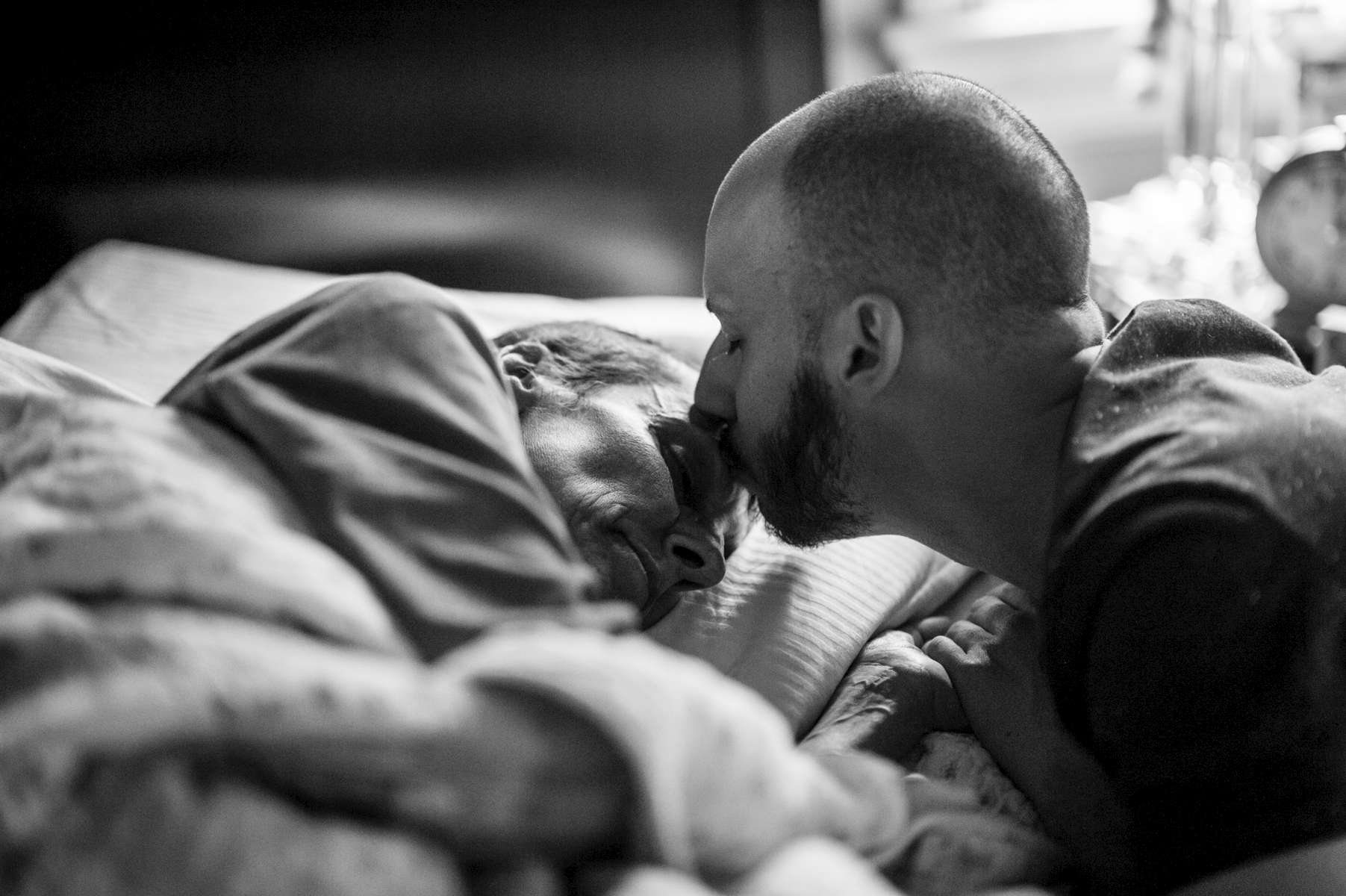
You were right. Everything happened suddenly, so quickly, everything so slow and yet dizzying, all of it soaked in awe and pain, everything inside me unraveling with every memory that tosses my soul into disarray: you holding me in your lap, you lying in the hospital bed, you bent over the looms, you raising a finger in suspicion, you caring for grandma, you kneading bread and putting it in the oven, you saying goodbye, intubated, covered in bruises, you radiant with joy, you in the coffin—cold as paper—when I kissed you one last time.
Next year, God knows!
Don’t say that, mother.
And I, all four of us, the five of us (for father belongs here too, of course), hallucinating, murmuring over lunch that today you would have turned 69, if you were alive. And I, we five, hating those verbs in the conditional, the subjunctive, as if you weren’t alive, as if you weren’t here, among us, listening with your mocking smile to “Happy Birthday to you, on this special day,” as if you’d fail us on a date so important, so unforgettable, so vividly awakened by morning’s small candle flickering beside the wooden box with the Virgin, Saint Joseph, and the Child.
Cancer intruded. I’ve always loathed my cowardice toward illness. I see you still, your lungs working in a terrible struggle, your fist pressed to your chest:
This son of a bitch won’t stop.
And us, eyes fogged over, noses dripping with sorrow, voices breaking in our throats:
Oh, mother of mine.
I swore—on the eve of your passing—that as long as I remain a person in this world, there would always be a light shining from the Holy Family, spreading through the cracks in the house, boldly pushing back the shadows, bringing in the friendly fire of a candle your steadiness, your sense, your resourcefulness, your sayings, your leadership, your way of telling stories with humor and no malice. I swore I would explain myself this way when the longing sometimes chokes me and punches me hard. The place for light is within metaphors. Light should say mother with the same solemn gentleness with which a flame says love.
Is it wrong to write too often about someone you love?
Herberto Helder once wrote in A Colher na Boca, 1961, what I believe is the purest justification for that love: “Mothers are the highest things / their children create, because they place themselves / in the combustion of their children, because / children stand like invading dandelions / in the fields of their mothers.” No verse could fit this chronicle more rightly or more luminously.
This won’t be the last time we sing you happy birthday, mother.
Don’t say that, children. Live your little lives.
And that’s why the light seems so delicate, so soft, so cathartic now that the night falls and the shadows—yes, I must say it again—arrive almost, as in Caravaggio, to be beautiful.