
EM NOME DA LUZ (2022)
.
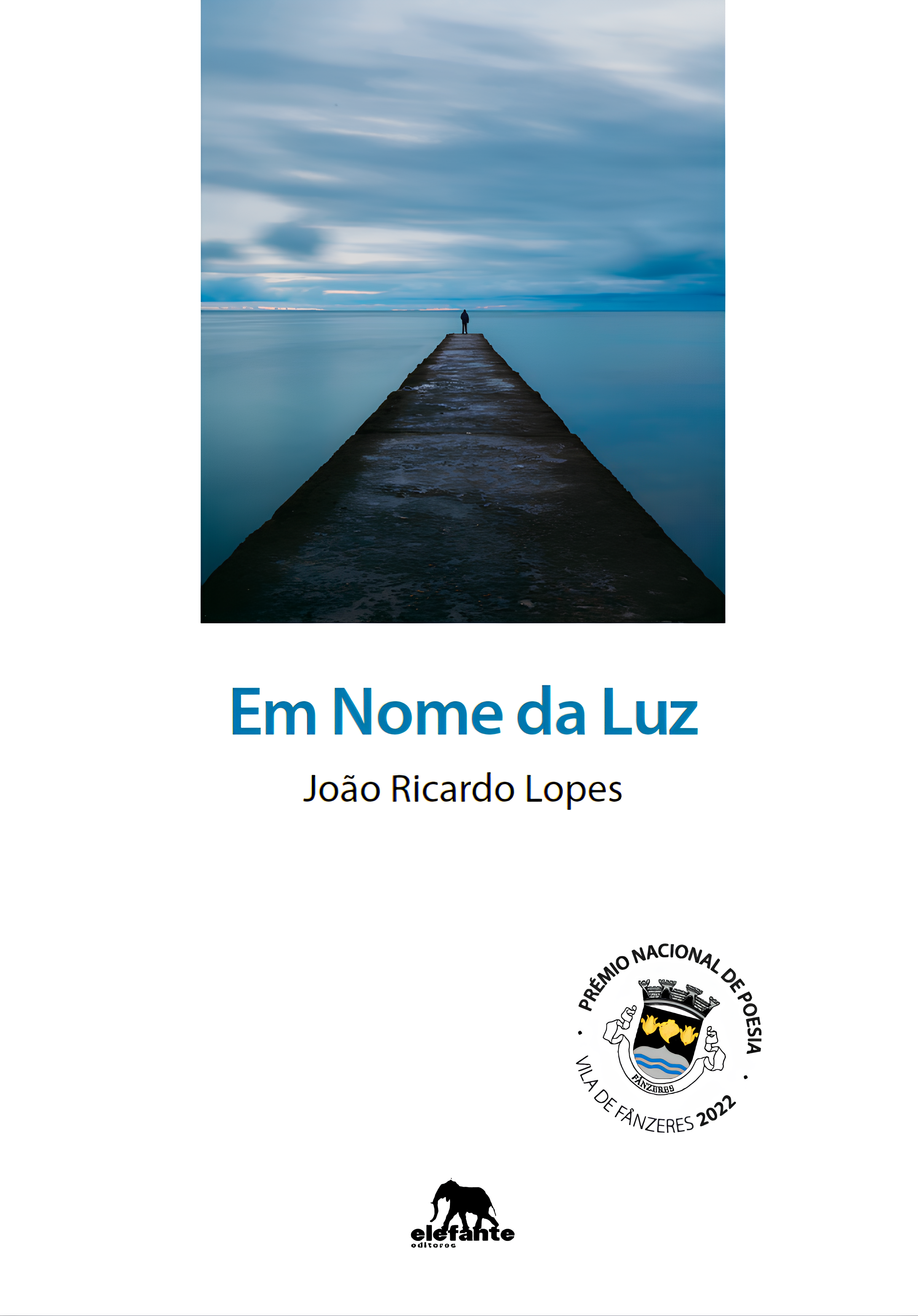
Among João Ricardo Lopes’s poetic works, the slender volume Em Nome da Luz (In the Name of Light) stands out. Comprising 40 short poems, it was awarded the National Poetry Prize of Vila de Fânzeres for its vivid imagery, lyrical strength, refined language, and carefully crafted structure.
Critic José António Gomes praised the collection as a meditation on time, place, and memory—built from fleeting illuminations and everyday simplicity, enriched by cultural references from music, film, and art. The poems address an intimate “you” and are marked by a serene, melancholic wisdom and distinctive poetic voice.
Paulo Jorge Miranda highlighted the book’s “poetics of silence,” rooted in introspection and minimalism. This aesthetic, present throughout Lopes’s work, aims to strip language to its essence, allowing the poem to emerge from silence as an act of quiet revelation.

.
EUTRAPELIA (2021)
.
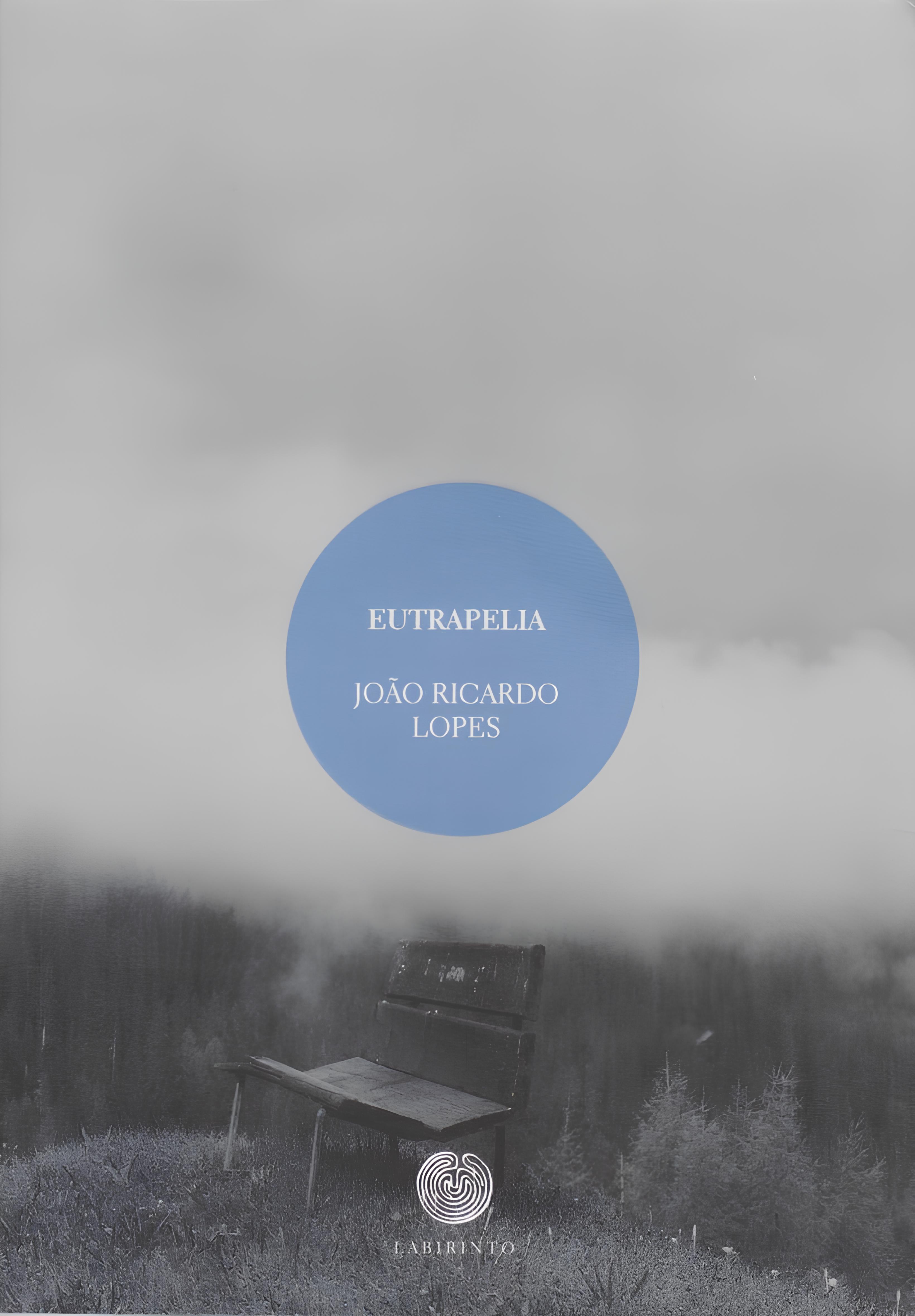
Eutrapelia (2021) marks João Ricardo Lopes’s return to poetry after a decade of silence, coinciding with the twentieth anniversary of his literary debut. Inspired by the ancient Christian virtue discussed by Dante in Convivio, this collection of fifty poems opens with a dedication to the author’s wife and a “Poetics” that affirms both an ethical and aesthetic stance: a defense of simplicity, of childhood, and of the quiet beauty that shapes human life.
Blending personal reflection with cultural pilgrimage, the poems trace a journey through physical and artistic landscapes of Europe—its literature, music, cinema, and visual arts. Figures such as Falstaff, Úrsula Iguarán, Tarkovsky, Vermeer, Rothko, Ravel, Coltrane, and García Márquez appear throughout the collection as symbols of wonder and inspiration.
Critics have noted the book’s sensorial richness and its meditative tone. Paula Morais emphasizes its evocation of memory, loss, and the fragile beauty of everyday life, while Cláudio Lima sees Eutrapelia as a kind of literary album—an intimate and wide-ranging tribute to cultural and spiritual legacy. The result is a poetic work steeped in lucidity, reverence, and a childlike awe before the world.
.
REFLEXÕES À BOCA DE CENA / ONSTAGE REFLECTIONS (2011)
.
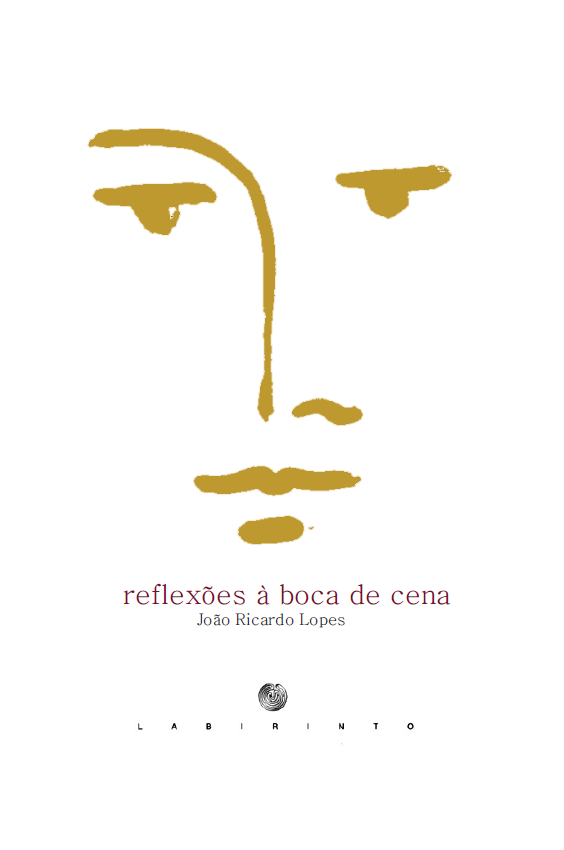
Ten years after his literary debut, João Ricardo Lopes published, in 2011, Reflexões à Boca de Cena / Onstage Reflections, in collaboration with Bernarda Esteves, who translated the fifty poems into English.
While preserving several thematic lines already present in his earlier works—particularly a metapoetic engagement with writing and a pessimistic tone that frequently edges into existentialism—this collection distinguishes itself through its strongly theatrical discursiveness. From within this performative tone arises a stark awareness: that every act is simultaneously its negation, and that writing is its own undoing, a fiction, a dramatic lie.
Critics have highlighted several key aspects of the collection:
César Freitas points to the recurring theme of pretence, seen in theatricality, poetic language, and everyday gestures, where illusion blurs the line between essence and appearance.
Andreia Brites, writing for Os Meus Livros, notes a pervasive sense of loss and a tension between binary oppositions—light/dark, inner/outer—through which the poems explore memory as fragment and love as absence.
Victor Oliveira Mateus describes the poetry as a search for unstable equilibrium, where living is a performance shaped by inner conflict, the passage of time, and fidelity to self, others, and the fragile miracle of life.
.
DIAS DESIGUAIS (2005)
.
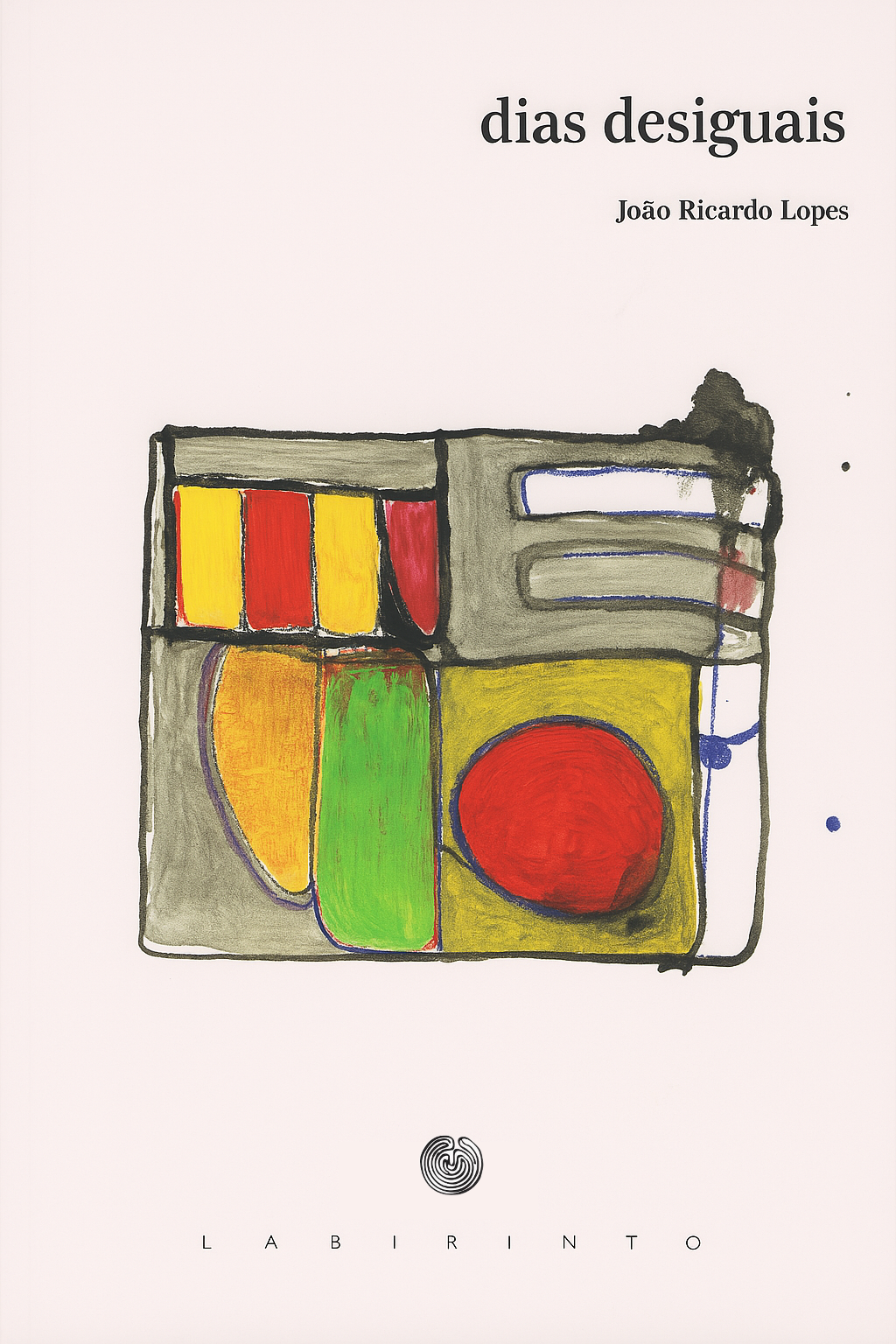
João Ricardo Lopes’s fourth poetry collection, Dias Desiguais (Uneven Days), consists of 56 poems influenced by the spirit of Wisława Szymborska, as reflected in its epigraph. Divided into three stylistically distinct sections, the book combines metapoetic reflection with subtle humor and a focus on the everyday.
Through simple objects, fleeting gestures, and natural imagery, Lopes explores the richness of ordinary life with a deeply humanist lens. Critics have praised the work for its apparent simplicity and attentiveness to detail, highlighting the poet’s ability to extract meaning from the overlooked—from broken plates to stray dogs—transforming “dust-covered words” into vibrant poetic material.
At its core, this book is a meditation on the asymmetry of experience, embracing life’s minor shifts and contradictions through a quiet, intimate lyricism.
CONTRA O ESQUECIMENTO DAS MÃOS (2002)

.
Contra o Esquecimento das Maõs (Lest Hands Be Forgotten, 2002) is the third and most extensive poetry collection by João Ricardo Lopes. It brings together a variety of compositions — in verse and prose poetry — organized into seven “panels” of twelve poems each. The passage of time serves as the leitmotif and unifying thread across the book’s 84 poems. The sequence of titles — “the place we came from,” “against the forgetting of hands,” “of the afternoons,” “a man’s night,” “memories,” “small inner islands,” and “of the silences” — points to the work’s existential dimension. These poems are marked by a deep awareness of finitude and an agonizing, often powerless, urge to resist death — as well as by the idea of writing as a womb-like return, a space for rebirth and re-experience.
Highly symbolic and allegorical, metapoetic and unmistakably experimental, this book resonates with the voices of poets such as Omar Khayyam, Jalal al-Din Rumi, T. S. Eliot, Paul Celan, Herberto Helder, Al Berto, and António Franco Alexandre.
ALÉM DO DIA HOJE (2002)
 .
.
.
Além do Dia Hoje (Beyond the Day That Is) is a poetry Collection by João Ricardo Lopes, winner of the 12th edition of the National Poetry Prize of the Town of Fânzeres, awarded by the local council in 2001, with the jury presided over by writer Fernando Campos.
The book revolves around the theme of metapoetry, with frequent allusions to the act of writing and the elements that materialize it (words, saliva, pen, ink, paper, notebook, A4 sheet, paragraphs, etc.).
Maria Fátima Saldanha, a member of the jury, wrote: “As one would expect from a young author, the fundamental issues of his literary invention cannot yet be considered definitive—an aspect that is, in itself, stimulating for all it allows us to anticipate regarding his potential.” At the same time, she noted that in this volume, “A philosophical writing gradually begins to take shape, one that is rooted in existentialist principles and subtly, yet deliberately, breaks away from the burden of inherited cultural legacies. Metaphysics and physics do not tear each other apart; rather, they presuppose one another: ‘beyond/ the belfry/ and the old iron bells// the cloud passes over/ the belfry/ and the bells have stopped/ ringing: the church may not even/ exist…// … only god, perhaps, passing/ over that cloud.’”
A PEDRA QUE CHORA COMO PALAVRAS (2001)
.
João Ricardo Lopes’s debut poetry collection, A Pedra Que Chora Como Palavras (The Stone Weeping Wordlike), was awarded the Ary dos Santos Revelation Prize for Poetry (7th edition, 2001), conferred jointly by the Municipality of Grândola and the Portuguese Writers’ Association. The jury—composed of José Correia Tavares, Armando Baptista-Bastos, and Manuel Frias Martins—unanimously recognised the work for its distinctive lyrical voice, which, in their words, “recalls and relives, in a dual temporal dimension, both carnal love and the love of writing, allowing them to converge in a single poetic gesture, one that the act of loving-writing lyrically enacts.”
The jury further underscored the collection’s aesthetic merit, describing it as “a book of love poems [featuring] images of unequivocal and meticulous beauty, situating its poetic focus both on the exaltation of the senses (of the body intensified by love) and on the disquieting resonance such physical exaltation evokes in the natural world.”
Comprising thirty-five poems, the collection is conceived as a formally cohesive whole, subtly articulated as a single extended poetic composition. The deliberate absence of individual titles and the sparing use of punctuation contribute to a visual and rhythmic continuity across the text—an effect that evokes a sustained grafomelodic line inscribed on the page. This formal strategy is echoed symbolically in the title itself, which suggests the synaesthetic convergence of language, emotion, and materiality.
