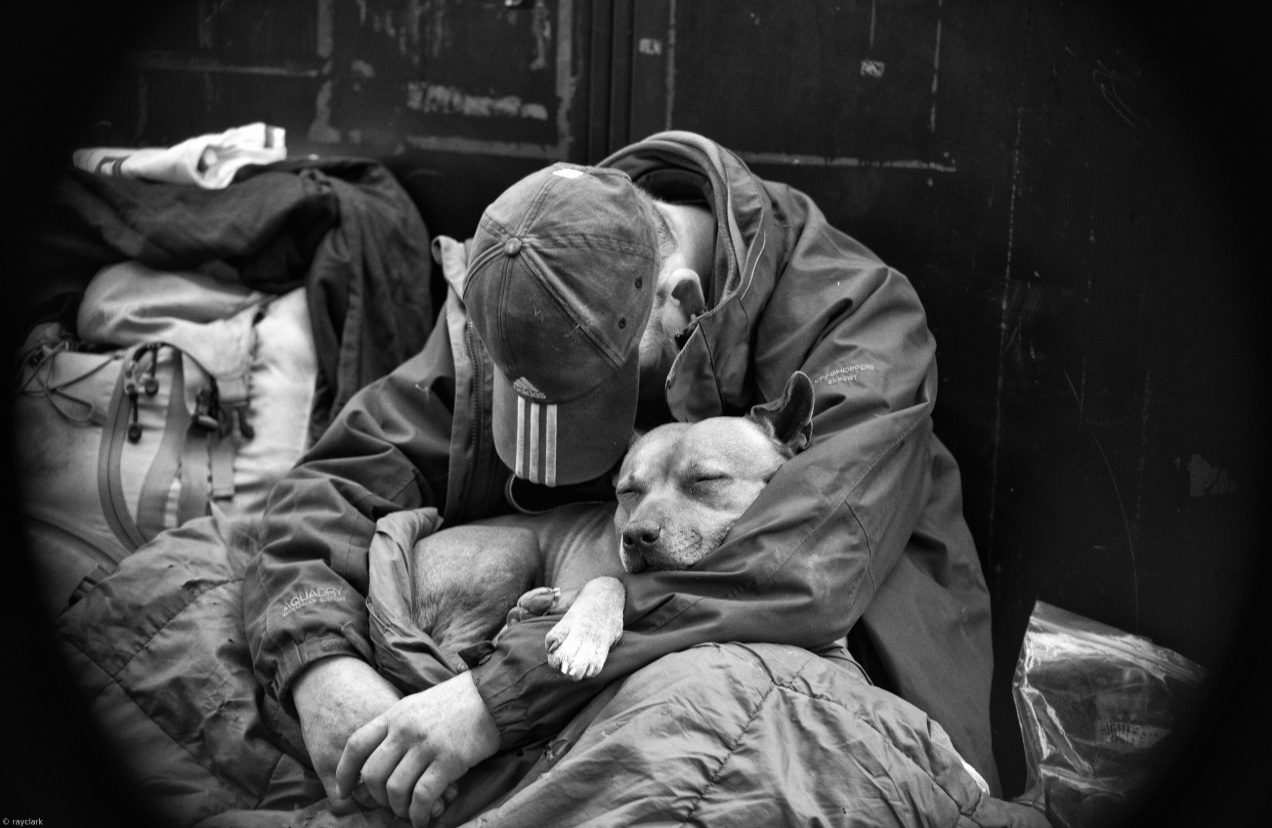

A Beggar

Photo by Ray Clarck

.

Certain phrases sound like the cold gleam of churches, Ricardo Navajo thought, as he stroked, lost to himself, the small dog at his side.

In this corner of the city, alms are, in a way, less miserly but far noisier. A man pressed to the ground hears everything, including words articulated with rote wisdom.

“We should feel grateful for what He has set aside for us and recognise that a crust of bread is as important as the beauty of the saxifrage.”

Whoever said it did so with a calm assurance that was at once the outward expression of a frantic search of the soul. Then, turning to his listeners in a kind of improvised sermon, he also said,

“Behold: there is a depth towards which the body weighs, and a whole sky towards which we must raise the soul. Beneath us the earth to cover us; above us the galaxies that shall guide our spirit for evermore.”

Ricardo Navajo scratched his chin with frozen fingers and long nails. Then he scratched his belly, unsettled by hunger. Next, he began to massage the nape of his mongrel companion, forgetting the plastic bowl where a few cents slept in peace.

At this corner of the city, people almost always walk in haste and almost never with pity. The conversations flung into the air are very much like fireworks: brief flares that glitter without warming.

The speaker has just gone into the Seminary with his disciples; cars blare their horns with steady ferocity; traffic lights open and close with the indifference of ancient gods.

Navajo has the habit of brooding on what others leave hanging as they pass by. Human thought, if there is any left, is organised like a structure of scaffolding. Each man sees the world in the way that suits him, supposing it to be unique and universal from the height, or the depth, of his own vantage point.

That there are beautiful flowers and stars around us, the beggar did not doubt. But a crust of bread and money so that the earth may receive our bones with dignity are another matter altogether.

Just now Navajo received the firm clink made by a one-euro coin. The Christmas season is a good harvest, he would reply, if anyone wished to know how life is going. He thanks it with a studied bow, while the palm of his hand runs along Riquinho’s back. That is the name of his best friend.

That is what he would say, if anyone asked him.

.

Torben Bjørnsen

Photo by Annie Spratt

.

There was a time in Torben Bjørnsen’s life when his deeds flowed easily and applause reached him from every side. Success seemed without limit and he carried it in his gestures and in his words, for he was a fine writer and an even finer orator. The initials TB gleamed on bookish placards and university periodicals, but above all on the flyers and posters set at the entrances of the packed lecture theatres where he appeared so often.

But that was another time.

With no explanation we might offer the reader, Torben Bjørnsen flung himself into a harsh flight of self-erasure: he refused interviews, turned down invitations, forgot patrons and admirers, and sealed himself in a troubling muteness and solitude, as though he had suddenly needed to transform the empathetic skin of his former self into an armour of scales and spikes. For almost two decades he has produced no new writings, not even the brief prose poems we cherished so much.

Celebrity was followed by resentment and vendetta.

A kind of hatred for the man has taken root in Denmark, a country which, like all others, accumulates both noble and rotten makers of public opinion. Some claim Torben fled the reach of justice, guilty of some offence drawn from the spectrum of social aberrations. Others explain his silence through a profound religious conversion, the sort one does not expect in days so stripped of spirituality as ours. There are those, too, who justify the change with a single word: weariness.

Ida Kjær, a mutual friend, told us recently that she meets him once a year.

Torben does not live in Greenland, in the Faroe Islands, nor on any of those islets on the way to Sweden. He lives where he has always lived, with his cat, with his collection of nativity scenes, with his endless notebooks where he scrawls emendations and runic symbols. “Only older, much older, and filled with that childlike glow that draws us, on this Saint Lucy’s Day, in a crowd to the lighted canals. Torben will be there, anonymous and content, sharing and receiving lussebullar. You’ll see!”

.

Matchticks

Photo by Vitaliy Shevchenko

.

The old man gathered every matchstick he could find. At first they took him for one of those model builders of castles and ships. But no one ever saw him create anything, not a single piece, and so, in time, they began to see him as a madman.

The small, burnt sticks give a beautiful sense of what our life is and what our death is. Some lose their heads easily, others keep their full ashen heads and charred bodies. When joined with patience and calm, they form palisades, bridges, rafts between the realm of the living and the realm of the dead. They resemble poems written to last a miraculous instant and a forever tinged with sorrow. One must understand them.

In December, when the days fade earlier, just before Christmas, they found the old man dead at home. He lay stretched on the floor, inside a gigantic cage made of thousands and thousands of those enchanting fragments of burnt wood. It was a poor mausoleum.

Whether it sheltered him or held him captive, no one has ever managed to understand from what, or why.

.